About the Journal
Journal of Law, Information & Science
About the Journal
Originally established in 1981 under the title Journal of Law and Information Science, the Journal of Law, Information & Science (JLIS) was founded at a time when the relationship between law and emerging computer and information technologies was still developing. The Journal was among the early scholarly forums dedicated to examining the legal, regulatory, institutional, and policy challenges arising from the increasing use of computers, information systems, and emerging technologies. Its foundational objective was to broaden understanding of the relationship between law and modern technology and to encourage meaningful academic dialogue at the intersection of these rapidly developing fields.
From its inception, the Journal recognized that technological development does not occur independently of legal systems. Advances in computing, information management, digital communication, and scientific innovation continually create new questions concerning rights, responsibilities, regulation, governance, liability, privacy, intellectual property, evidence, professional practice, and access to information. The Journal therefore sought to provide an interdisciplinary platform through which legal scholars, scientists, technologists, policymakers, practitioners, and researchers could critically examine these emerging challenges.
As information technology matured and became increasingly integrated with scientific research and technological innovation, the intellectual scope of the Journal expanded beyond the traditional relationship between law and computing. The Journal adopted its present title, Journal of Law, Information and Science, in 2005 to reflect this broader remit and the growing overlap between law, information technology, and the sciences. The expanded scope also reflected the founding vision that the Journal should provide a forum for legal scholarship concerning emerging science and technology.
Over time, the Journal's scholarship has addressed a diverse range of contemporary issues, including artificial intelligence and expert systems, computer and information law, intellectual property, privacy and data protection, electronic commerce, genomics, biotechnology, nanotechnology, bioethics, blockchain and distributed ledger technologies, drones, online platforms, digital advertising, cybersecurity, and the regulation of emerging technologies. Its published scholarship demonstrates the importance of interdisciplinary approaches to understanding how technological and scientific developments influence legal institutions and society.
Today, the Journal of Law, Information & Science seeks to continue this tradition by serving as a forum for rigorous scholarly research, critical dialogue, and informed debate on the evolving relationship between law, information, science, and technology. The Journal welcomes scholarship that not only identifies legal challenges created by technological and scientific innovation but also critically examines the adequacy of existing legal frameworks and considers possible approaches to regulation, governance, accountability, and policy development.
Aim of the Journal
The principal aim of the Journal of Law, Information & Science is to advance interdisciplinary scholarship concerning the relationship between law, science, information, and technology. The Journal aims to:
-
promote high-quality, original, and rigorous research on contemporary legal issues arising from scientific and technological developments;
-
provide a scholarly platform for examining the interaction between legal systems and emerging technologies;
-
encourage interdisciplinary dialogue among legal scholars, scientists, technologists, social scientists, policymakers, practitioners, and other researchers;
-
examine how technological innovation affects legal principles, institutions, rights, responsibilities, and regulatory frameworks;
-
critically evaluate existing laws and policies in light of technological and scientific change;
-
explore emerging approaches to technology governance, regulation, ethics, accountability, and public policy;
-
contribute to academic and professional debates concerning the opportunities, risks, and societal consequences of technological and scientific innovation; and
-
encourage forward-looking scholarship that anticipates legal and regulatory challenges associated with emerging technologies.
The Journal is particularly interested in research that goes beyond merely describing technological developments and instead provides substantive legal, theoretical, empirical, comparative, interdisciplinary, or policy-oriented analysis of their implications.
Scope of the Journal
The scope of the Journal of Law, Information & Science is interdisciplinary and encompasses legal issues arising from information technologies, scientific developments, and emerging technological systems. The Journal welcomes original research, theoretical scholarship, comparative studies, empirical research, policy analysis, and critical interdisciplinary contributions in areas including, but not limited to:
1. Law and Information Technology
-
Information technology law
-
Computer law
-
Internet and cyberspace law
-
Digital law and regulation
-
Information systems and legal institutions
-
Technology and the legal profession
-
Legal informatics and computational law
-
Digital courts and technology-enabled justice
2. Artificial Intelligence and Emerging Technologies
-
Artificial intelligence and law
-
Generative AI and legal regulation
-
Machine learning and automated decision-making
-
Algorithmic accountability and transparency
-
AI governance and ethics
-
Autonomous systems and robotics
-
Expert systems and computational legal reasoning
-
Liability for AI-generated or AI-assisted decisions
3. Data, Privacy and Information Governance
-
Data protection and privacy
-
Personal and non-personal data governance
-
Information security and cybersecurity law
-
Data ownership and access
-
Cross-border data flows
-
Surveillance and monitoring technologies
-
Data governance and accountability
-
Digital identity and authentication
4. Intellectual Property and Digital Innovation
-
Copyright and software
-
Patents and emerging technologies
-
Trade marks and digital platforms
-
Open-source technologies
-
Digital content and licensing
-
Artificial intelligence and intellectual property
-
Technology transfer and innovation
-
Protection of databases and digital assets
5. Science, Medicine and Biotechnology
-
Law and genomics
-
Biotechnology and genetic technologies
-
Biomedical research regulation
-
Bioethics and health technologies
-
Medical artificial intelligence
-
Digital health and electronic health records
-
Human enhancement technologies
-
Gene editing and reproductive technologies
6. Technology, Commerce and Digital Society
-
Electronic commerce
-
Digital markets and platforms
-
Online contracts and transactions
-
FinTech and digital financial services
-
Blockchain and distributed ledger technology
-
Cryptocurrency regulation
-
Digital advertising and consumer protection
-
Platform governance and intermediary liability
7. Emerging Scientific and Technological Developments
-
Nanotechnology and the law
-
Drones and autonomous vehicles
-
Internet of Things
-
Quantum technologies
-
Robotics
-
Biotechnology
-
Space technology and law
-
Environmental and climate technologies
-
Other emerging technologies with significant legal or regulatory implications
8. Technology, Society, Ethics and Human Rights
-
Technology and fundamental rights
-
Freedom of expression in digital environments
-
Equality and non-discrimination in automated systems
-
Digital inclusion and access to technology
-
Technology and democratic governance
-
Ethical dimensions of scientific innovation
-
Human rights implications of emerging technologies
-
Social and institutional consequences of technological change
9. Comparative, International and Policy Perspectives
The Journal welcomes comparative and international scholarship examining how different jurisdictions respond to technological and scientific developments. Contributions may examine national legislation, international instruments, regulatory models, judicial decisions, institutional practices, and emerging approaches to technology governance.
Our Scholarly Mission
The Journal of Law, Information & Science is committed to advancing scholarship that recognizes that law, science, information, and technology are increasingly interconnected. The Journal seeks to facilitate constructive debate about how legal systems should respond to innovation while ensuring that technological and scientific progress remains consistent with principles of justice, accountability, privacy, human dignity, equality, security, and the rule of law.
The Journal therefore encourages scholarship that is innovative, interdisciplinary, critical, and forward-looking, particularly research capable of contributing to both academic discourse and the development of sound legal and public policy responses to emerging technological and scientific challenges.
Through its broad interdisciplinary scope, the Journal aims to remain a forum for examining not only the legal consequences of technological change but also the ways in which law can shape, guide, and responsibly govern the development and use of emerging science and technology.
Current Issue
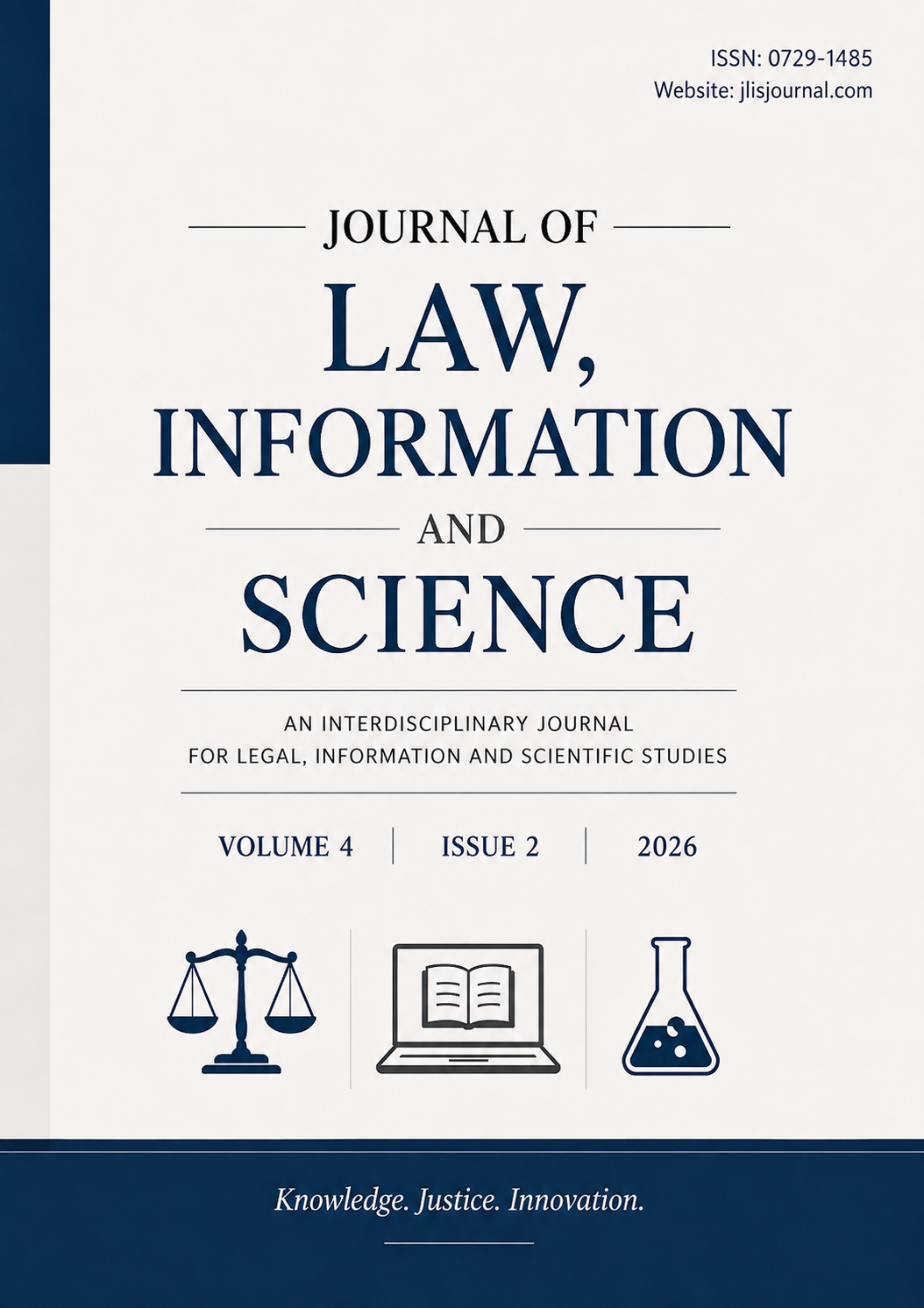
Vol. 4 No. 2 (2026): Articles
Published:
2026-12-31